
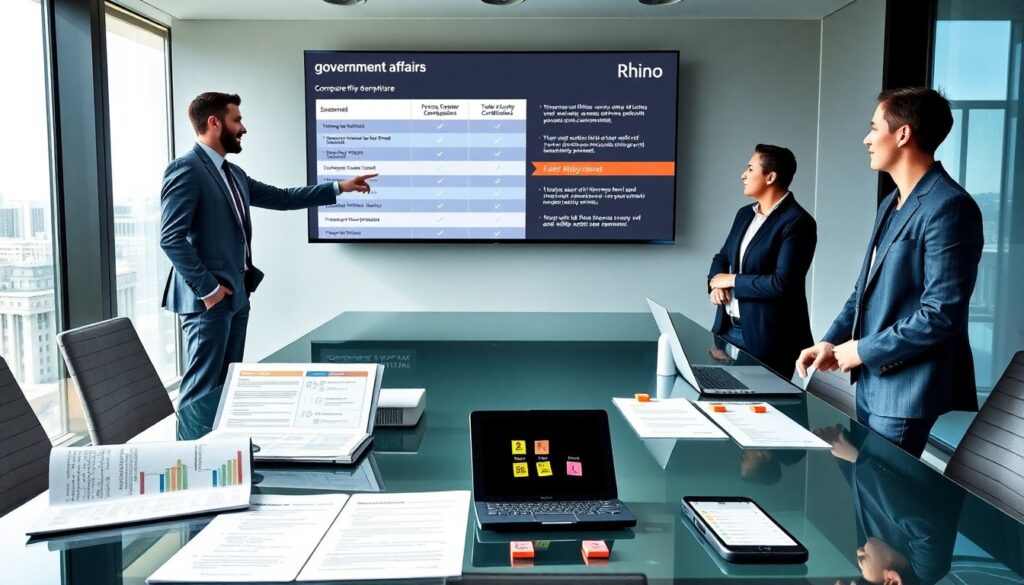
They search government affairs rhino comparing prices testimonials spearstotere to choose tools that fit their budgets and goals. The guide lists clear criteria. It explains pricing models. It shows how to read testimonials. It points out red flags. The guide helps buyers make direct comparisons and avoid common errors when they evaluate these platforms in 2026.
Key Takeaways
- Evaluating government affairs platforms requires ranking core features like legislation tracking, contact management, automation, reporting, and compliance tools to match organizational goals.
- Comparing pricing models involves analyzing total cost of ownership, including licensing, implementation, support, and potential extra fees over a multi-year horizon for accurate budgeting.
- Vetting testimonials and case studies means verifying industry relevance, contacting references, and looking for specific metrics to avoid misleading or vague claims.
- Security and privacy certifications such as SOC 2 or ISO, along with encryption and multi-factor authentication, are critical criteria for assessing platform trustworthiness.
- Integration capabilities with existing CRM, email, and document systems should be tested for stability, ease of onboarding, and ongoing compatibility with vendor updates.
- Using a weighted scorecard to compare cost, features, security, and support makes government affairs rhino comparing prices testimonials spearstotere evaluations transparent, repeatable, and aligned with business priorities.
Critical Features And Capabilities To Evaluate
Stakeholders list core needs before they compare government affairs rhino comparing prices testimonials spearstotere. They define goals. They rank features. They check whether each platform tracks legislation, manages contacts, automates outreach, and logs engagements. They test reporting tools. They verify exports and API access. They confirm role-based permissions and audit logs. They check data sources and update frequency. They confirm lobbying compliance tools and calendar integrations.
Buyers verify search and alert functions. They run sample queries and set alerts. They time response speeds. They check whether the system flags bill changes and committee actions. They compare how each product maps stakeholder influence. They review visualization options for reports and maps. They ask about bulk import limits and file formats. They measure mobile access and offline capabilities.
Security and privacy matter in public affairs. Buyers request SOC 2 or ISO certifications. They ask about encryption at rest and in transit. They ask for retention policies and deletion procedures. They confirm single sign-on and multi-factor authentication options. They require clear SLA terms for uptime and support response times.
Integration options shape long-term value. Buyers list existing CRM, email, and document systems. They test connectors and middleware. They ask whether vendor updates break integrations. They confirm sandbox access for testing. They rate ease of onboarding and training resources. They count administrator seats and training hours offered.
Finally, buyers score each product on scalability and roadmap. They ask product teams for release cadences. They request feature roadmaps and user community activity. They check user forums and product update logs. These steps let buyers compare government affairs rhino comparing prices testimonials spearstotere on practical, mission-critical capabilities.
Pricing Models, Total Cost Of Ownership, And How To Compare Quotes
Vendors use different pricing models for government affairs rhino comparing prices testimonials spearstotere. Some charge per user. Some charge per module. Some use usage tiers. Buyers request full quotes that include setup, migration, and training. Buyers ask for sample invoices and typical cost ranges for organizations of similar size.
Buyers calculate total cost of ownership. They add license fees, implementation fees, integration work, and internal staff time. They add database hosting and support costs. They add renewal increases and required third-party connectors. They ask whether analytics or custom reports cost extra. They confirm who pays for API calls over threshold.
They compare quotes line by line. They normalize time horizons to three years. They compute per-user, per-year costs. They model expected headcount changes and scale costs. They run sensitivity tests for adoption rates and extra features. They request net present value of multi-year contracts if the organization prefers capital planning.
Buyers negotiate terms. They ask for pilot pricing or proof-of-value periods. They request caps on annual price increases. They seek clear exit terms and data portability guarantees. They ask for early termination fees and data retrieval fees. They require a migration plan and sample timelines.
Buyers evaluate ROI. They list measurable outcomes such as reduced research time, increased stakeholder meetings, or faster response to legislation. They estimate time savings and convert them to dollars. They stress-test vendor promises against real workflows. They favor vendors who provide clear pilot metrics and success criteria.
Finally, buyers compare government affairs rhino comparing prices testimonials spearstotere quotes by using a weighted scorecard. They assign weights to cost, features, security, and support. They document assumptions. They present the scorecard to decision makers. This process makes price comparisons transparent and repeatable.
Reading Testimonials, Verifying Case Studies, And Spotting Red Flags
Buyers read testimonials to see real outcomes for government affairs rhino comparing prices testimonials spearstotere. They note who gives the testimonial and their role. They check for industry match and organization size. They prefer case studies with specific metrics and timelines. They treat vague praise as low evidence.
Buyers verify case studies. They contact references listed in case studies. They ask specific questions about implementation time, actual costs, and achieved outcomes. They ask whether the vendor met deadlines and whether support was responsive. They request raw output samples such as reports or dashboards used during the case.
Buyers watch for red flags. They suspect overly broad claims without numbers. They flag testimonials that use stock photos or anonymous quotes. They question sudden five-star surges and many brief posts with similar wording. They check third-party review sites and look for consistent themes in complaints.
Buyers validate online reviews. They cross-check dates and read negative reviews closely. They assess how the vendor responds to complaints. They prefer vendors that address issues publicly and show corrective steps. They look for repeated problems such as slow support, hidden fees, or frequent outages.
Buyers review contract copies when possible. They look for service levels promised in testimonials and for clauses that contradict claims. They ask vendors to sign pilot agreement terms that reflect testimonial claims. They require measurable KPIs in pilot contracts.
Buyers test vendor transparency. They ask for anonymized customer data or demo environments. They ask for customer advisory board notes or user conference recordings. They check whether product updates address customer requests. These checks help buyers compare government affairs rhino comparing prices testimonials spearstotere on real, verifiable evidence rather than marketing language.